

Code That Cures: Exploring Generative AI Applications in Health
Generative AI has significant potential to transform the Health Tech industry. Here are some emerging use cases where generative AI can make a substantial impact:
Automated Clinical Notes Generation
Generative AI can transform patient interactions into structured clinical notes in seconds.
Clinicians record patient visits using an AI platform’s mobile app. The platform adds real-time patient information, identifies gaps, and prompts clinicians to complete the notes. This near-instantaneous process automates manual note-taking and administrative work, improving efficiency and accuracy.
Clinical Decision Support
Generative AI can assist healthcare professionals by providing evidence-based recommendations. It analyzes patient data, medical literature, and historical cases to suggest personalized treatment options. Clinicians can make informed decisions, enhancing patient care and outcomes.

Healthcare Administration Optimization
Generative AI streamlines administrative tasks such as appointment scheduling, billing, and claims processing. It automates repetitive workflows, reducing errors and freeing up staff time for more critical tasks.
Drug Discovery and Development
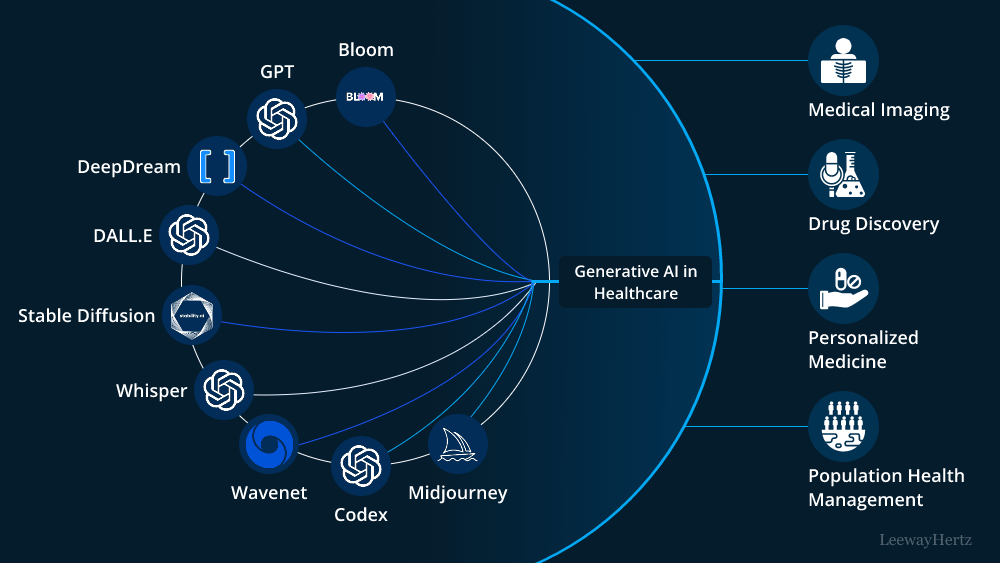
Generative AI accelerates drug discovery by generating novel molecular structures.
It predicts potential drug candidates, optimizing R&D efforts and shortening development timelines.
Medical Imaging Enhancement
Generative AI improves diagnostic accuracy by enhancing medical images.
It can denoise, sharpen, and reconstruct images, aiding radiologists in detecting abnormalities.
Personalized Treatment Plans
Generative AI analyzes patient data to recommend tailored treatment options.
It considers individual factors such as genetics, medical history, and lifestyle, leading to more effective interventions.
Healthcare Research and Insights
Generative AI can mine vast amounts of unstructured data (clinical notes, diagnostic images, etc.). Researchers gain insights into disease patterns, treatment effectiveness, and population health. Generative AI holds immense promise for revolutionizing healthcare, but it also requires careful consideration of data security, ethical use, and human oversight.

Write a Comment