

What Makes Something a Chatbot
A chatbot, in the traditional sense, matches user input against a defined set of intents and responds from a scripted flow or a shallow decision tree. Some are purely rule-based (keyword matching, button-driven menus); more modern ones use NLU models to classify intent more flexibly, but the underlying shape is the same: a known, bounded set of things it can do, and a human-authored path for each one.
That's not a limitation in every context — for FAQ deflection or simple order-status lookups, a well-scoped chatbot is often the right, cheaper tool. The failure mode shows up when a request falls outside the scripted paths: a chatbot can't reason its way to a reasonable answer, it just has no path to take.
What Makes Something an AI Agent

An AI agent is built around a language model that can reason about a goal, break it into steps, and call tools or APIs to carry them out — checking a calendar, looking up an order, updating a record — without every path being pre-scripted by a human.
The practical difference from a chatbot isn't "it's smarter," it's architectural: an agent's behavior comes from the model reasoning over the current context plus the tools available to it, not from a decision tree someone drew in advance. That's what lets an agent handle a request nobody explicitly anticipated, as long as it has the right tools and enough context to work with — and it's also why agents need more careful guardrails than chatbots do, since the model has more latitude in how it gets to an answer. Architecting that tool access and those guardrails correctly is most of the engineering work behind our conversational AI and voice agent builds.
What Voice Adds on Top of Either One
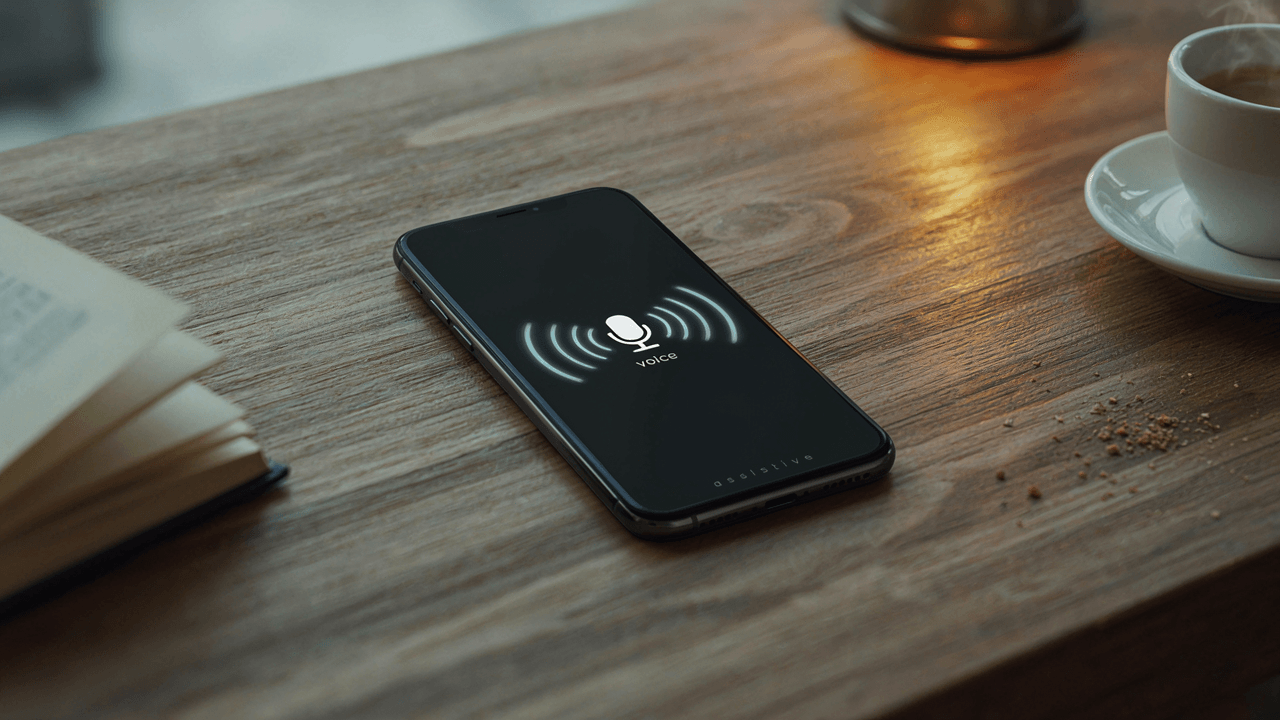
A voice agent is a chatbot or an AI agent operating over a live voice channel instead of text, and that channel adds constraints neither text system has to handle. Speech has to be transcribed in real time (ASR), processed, and spoken back (TTS) inside a latency budget tight enough that the conversation still feels natural — anything much past a second of dead air reads as broken to a caller.
The system also has to handle turn-taking: knowing when a caller has actually finished speaking versus just paused, and supporting barge-in, where a caller interrupts mid-response and the system has to stop talking and listen. None of that exists in a text-based chat, where there's no real-time pressure and no audio stream to manage — it's a meaningfully different engineering problem layered on top of whichever reasoning system (chatbot or agent) sits underneath it. It's exactly the layer our Calyvo voice agent product is built to handle, on top of the same conversational AI and voice agent engineering discipline described above.
Which One Actually Fits Your Use Case
The right choice depends on how bounded the task is and which channel it needs to run on. A narrow, high-volume, text-based task (order status, FAQ deflection) usually doesn't need an agent's flexibility — a well-built chatbot is cheaper to build and easier to audit. A task that genuinely requires multi-step reasoning across varied requests (triaging a support ticket, handling an open-ended booking change) is where an agent's architecture earns its complexity.
And anything that needs to happen over a phone call — handling a missed call, taking a booking by voice — needs the real-time speech pipeline regardless of how simple or complex the underlying reasoning is, which is the problem Calyvo is built around. If you already know you need a conversational system of some kind, our guide to designing conversational AI applications walks through the end-to-end design process once you've picked the right category.
Conclusion
Need to figure out whether a chatbot, an AI agent, or a voice agent is the right fit for your use case — and get it built? TechSchweiz's conversational AI and voice agent engineering team scopes the right architecture for your business and ships it end-to-end. Contact TechSchweiz today to discuss your project.