
De-Identifying Data Before It Ever Reaches the Model
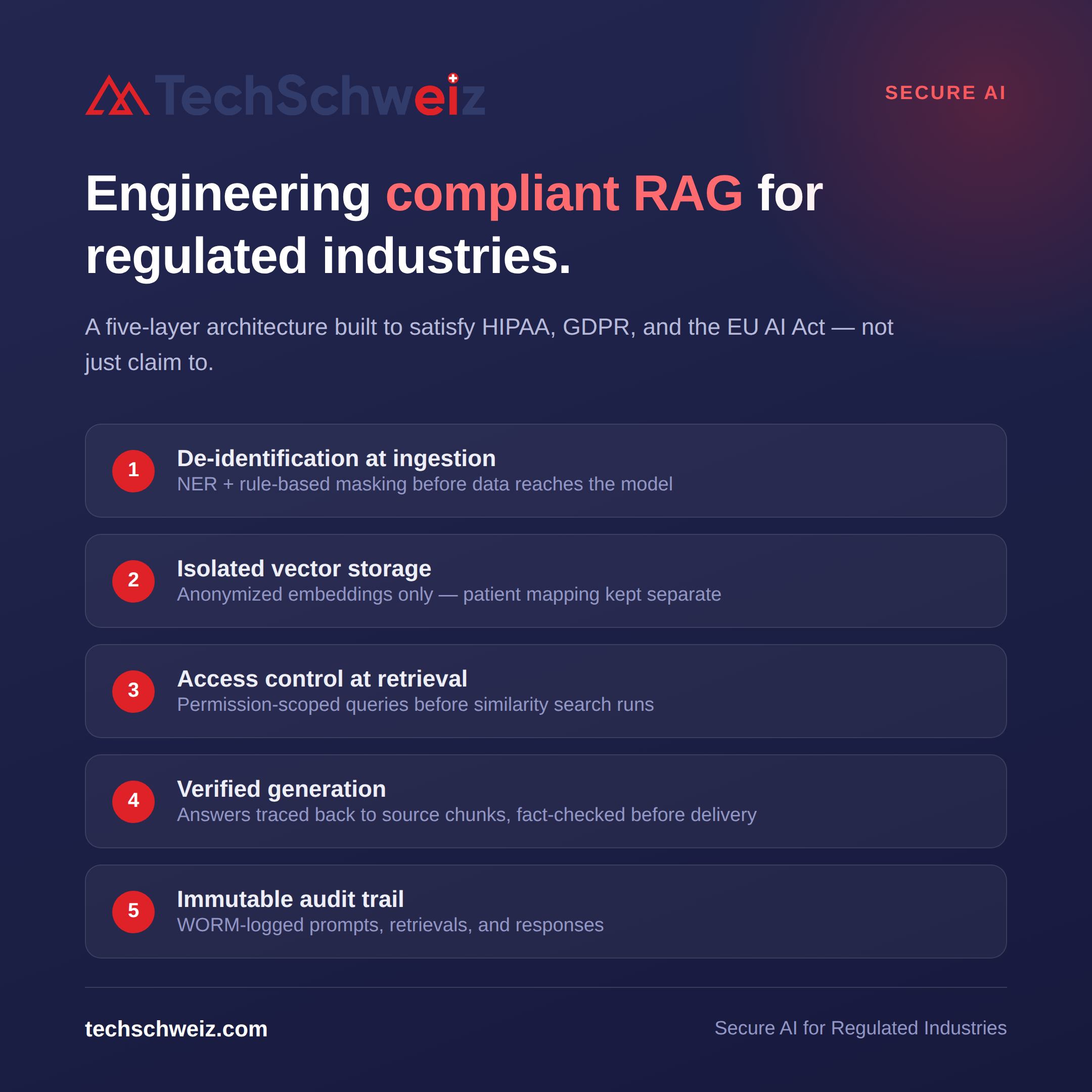
To meet HIPAA's Safe Harbor method, raw text has to be treated before it reaches an embedding model or vector database. That means hybrid de-identification: rule-based matching for structured identifiers like Social Security numbers and phone numbers, combined with Named Entity Recognition models trained on clinical text (tools like John Snow Labs Spark NLP or Microsoft Presidio are common choices) to catch unstructured identifiers buried in narrative notes. Rather than simply redacting names and Medical Record Numbers, the stronger approach is pseudonymization — swapping identifiers for consistent tokens (Patient_A, Clinic_X) so the model can still reason across a patient's history without ever seeing who the patient actually is.
Isolating the Vector Store
Vector embeddings aren't as anonymous as they look — they're vulnerable to inversion attacks that can reconstruct original text from high-dimensional vectors, so the infrastructure around them has to be treated accordingly. Any cloud-hosted vector solution (Pinecone Enterprise, AWS OpenSearch) needs an executed Business Associate Agreement in place; for stricter GDPR data-residency requirements, that often means pinning to EU-sovereign infrastructure or running a self-hosted, air-gapped instance of something like Qdrant or Milvus.
Just as important: the vector database itself should hold only anonymized embeddings and synthetic identifiers. The actual mapping back to real patient records belongs in a separate, heavily encrypted relational store, reachable only through a tightly restricted internal service. This is exactly the kind of infrastructure decision our secure AI for regulated industries team works through before a single embedding gets generated.
Access Control at the Retrieval Layer, Not Just the Application Layer
A standard RAG pipeline retrieves by similarity alone — which creates a real risk that a user could surface patient data they were never authorized to see. The fix is metadata pre-filtering: every query should pass an explicit permissions filter (provider ID, department scope, and similar ownership tokens) before vector distance is even calculated, not after.
Retrieval should never run as a raw, unscoped similarity search in a regulated pipeline. If your retrieval layer isn't enforcing this today, it's usually the first gap we find when we audit a regulated AI system.
Deterministic Guardrails and Provable Auditability
Two things matter once the model is generating: what it's allowed to say, and what can be proven about how it said it. On generation, answers should be explicitly restricted to what can be mapped back to a retrieved source chunk, with citations to specific document IDs, pages, or timestamps — and a secondary evaluation step (tools like Ragas, or a deterministic alignment check) should compare the answer against the retrieved context and intercept anything that falls below a high factual-alignment threshold, rather than surfacing unverified output to a clinician.
On the audit side, every prompt, retrieved chunk, model version, and response should be logged to immutable, Write-Once-Read-Many storage (for example, S3 with Object Lock) under a retention policy — commonly six years, to satisfy HIPAA's § 164.312(b) audit trail requirement — so the system can show exactly how any output was derived. It's the same standard we hold our own delivery process to; see our Trust & Security center for how we approach it.
Conclusion
None of this happens by bolting a compliance checklist onto a finished chatbot — it has to be architected in from the de-identification layer up. If you're scoping a compliant RAG pipeline for a health tech product, our AI consulting and engineering team can help design it end to end, from data handling through audit logging. Contact TechSchweiz today to discuss your project.